


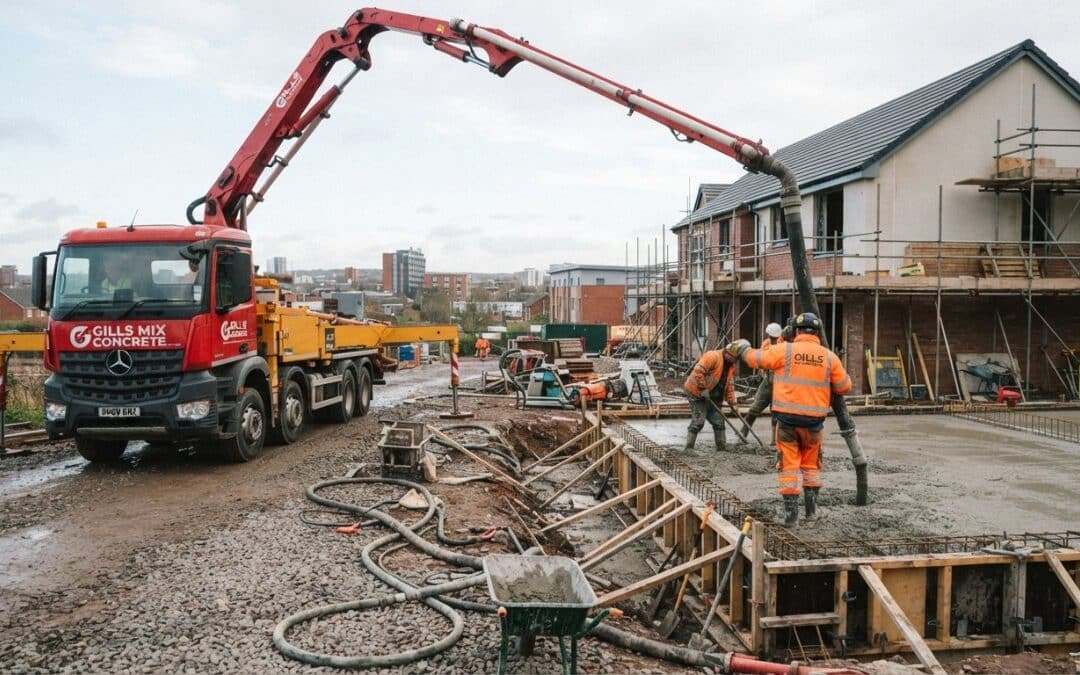
Quick Summary
Concrete pump hire lets a crew place wet concrete exactly where it is needed, even when a ready-mix lorry cannot get close. Choose a boom pump for large pours and open sites, and a line pump for smaller jobs and tight access.
- Walk the site and check access, pour volume and delivery window before booking any pump.
- Boom pumps suit large pours, multi-storey work and open sites with firm, level standing ground.
- Line pumps suit smaller pours and restricted access; keep hose runs as short and straight as possible.
- Ask quotes to state pump type, minimum hire period, travel charge, waiting-time rate and washout terms.
- Never let anyone stand at the end of a hose line during pumping, as hoses can whip if a blockage clears.
Table of Contents
- Why Concrete Pump Hire Matters on Difficult Sites
- Boom Pumps Versus Line Pumps: Choosing the Right Machine
- Concrete Line Pump Hire for Tight and Restricted Access
- Concrete Pump Reach, Access and Site Requirements
- What Affects the Cost of Concrete Pump Hire
- Pour-Day Checklist and Common Booking Mistakes
- Booking Your Concrete Pump and Getting a Quote from Gills Mix Concrete
- Frequently Asked Questions
Why Concrete Pump Hire Matters on Difficult Sites
Concrete pump hire lets a crew place wet concrete exactly where it is needed, even when a ready-mix lorry cannot get close.
Pumping is most useful on difficult sites: back gardens, terraced streets, first-floor pours, narrow driveways and sites with no room for a chute.
Before booking, confirm the site access, the pour volume and the delivery window. These three details decide which machine you need and whether a pump is worth the cost.
Boom Pumps Versus Line Pumps: Choosing the Right Machine
Two main types of pump are commonly used on concrete sites: boom pumps and line pumps. They do different jobs, and choosing the wrong one wastes money or stops the pour altogether. The decision comes down to four questions: how far the concrete must travel, how high it must go, how much space the pump vehicle needs, and how big the pour is.
A boom pump is a truck-mounted articulated arm that places concrete at height and distance. A line pump is a smaller unit that pushes concrete through a flexible hose, usually from the ground. Your site layout, pour size and access decide which one suits.
When a Boom Pump Is the Better Choice
A boom pump suits large pours, multi-storey work and open sites where the truck can park safely on firm ground. Its reach means you can pour across a slab or into elevated formwork without moving the vehicle repeatedly.
The trade-off is space. A boom pump needs a firm, level standing area for the outriggers and a clear sweep for the arm.
When a Line Pump Makes More Sense
A line pump is the better option for smaller pours, restricted access and places where a boom cannot reach. It is also easier to position in tight spaces. Many domestic and groundwork jobs are better served by a line pump where access is too awkward for a large vehicle.
The trade-off here is hose length and route. A line pump sits at the nearest point the vehicle can reach, and the concrete travels through hose lines to the pour location.
A Practical Way to Decide
Work through these steps before booking any pump:
- Measure the distance from the nearest safe parking point to the furthest pour point. If it is a long run, a boom may be cheaper than many lengths of hose and the labour to move them.
- Check the height. Any pour above ground floor, or over an obstruction such as a wall or extension, usually points to a boom unless a line pump can be positioned close enough.
- Assess the standing area. Confirm the ground is firm and level, the outriggers have room, and there is clear overhead clearance for a boom.
- Estimate the volume. Large volumes favour a high-output boom; small volumes favour a line pump on a shorter minimum hire period.
- Walk the hose route. For a line pump, confirm the gate widths, corners and any overhead cables along the route.
A common mistake is booking a boom pump for a site that can only take a line pump, or the reverse. Walk the route before you book and measure the gap between the kerb and the pour point. If you are unsure, describe the site when you request a quote and ask which machine suits the job.
Concrete Line Pump Hire for Tight and Restricted Access
Line pump hire is the solution for narrow side passages, rear gardens and houses with no drive. The pump sits at the nearest point the vehicle can reach, and the concrete travels through hose lines to the pour location.

Keep the hose runs as short and straight as possible. Long, bent runs increase pumping pressure and the chance of a blockage.
When you request a quote, it helps to describe your access, including the nearest kerb point, the gate width, any overhead cables and the distance to the pour location, so the right set-up can be planned in advance. Our concrete pump hire options for restricted sites cover the machines suited to these situations.
Concrete Pump Reach, Access and Site Requirements
Pump reach and capacity determine whether a pump can do the job. Boom pumps are rated by the reach of their arm, and line pumps by the length and bore of their hose lines.
Check these points before the pump arrives:
- A firm, level standing area for the pump and outriggers
- Clear access for the pump vehicle and the ready-mix lorry
- Overhead cables or branches that could obstruct the boom
Health and safety matter here (The absolutely essential health and safety toolkit for the smaller construction contractor).
The table below summarises the main site checks to make before the pump arrives.
| Check | Why it matters | Note |
|---|---|---|
| Standing area | Pump and outriggers need support | Firm and level ground |
| Vehicle access | Pump and ready-mix lorry must reach site | Clear route for both |
| Overhead cables | Could obstruct the boom | Check before the pump arrives |
| Hose route | Keeps lines safe and unobstructed | Protect where lines cross paths |
| Labour | Concrete must be placed as it arrives | Enough people ready on the pour |
| Public safety | Hose whip is a real hazard | Keep the area clear during pumping |
What Affects the Cost of Concrete Pump Hire
Pump hire is usually priced on the individual job rather than a fixed rate, because the same machine can cost very different amounts depending on how it is used.
The main cost drivers are:
- Pump type and size. A boom pump carries a higher day rate than a line pump because of the vehicle, the operator and the setup time. A larger boom with more reach costs more than a compact unit, so booking more reach than you need is money wasted.
- Minimum hire period. Suppliers often charge a minimum hire period, even if the pour takes a short time. If your pour is small, a line pump on a half-day minimum is usually the cheaper route.
- Concrete volume and output rate. Pumping is charged partly on the volume moved and partly on the time it takes. A high-output boom can place a large slab quickly, but on a small pour the setup time dominates the bill.
A common pattern is that customers focus on the headline day rate and miss the minimum period and waiting-time terms.
For current prices, contact Gills Mix Concrete directly and request a quote based on your volume, date and site access. Our guide to what affects ready mix concrete prices in the West Midlands explains the factors behind the figures you will be quoted.
Pour-Day Checklist and Common Booking Mistakes
On the day of the pour, use this checklist:
- Confirm the delivery and pump arrival times with the site
- Clear the access route and the standing area for the pump
- Lay out hose protection and a clear route
A common booking mistake is underestimating the volume. Running short mid-pour creates a cold joint, which weakens the slab. Another is failing to check access before the day, which can leave the pump stranded at the kerb.
Watch out: never let anyone stand at the end of a hose line during pumping. Hoses can whip if a blockage clears suddenly.
Booking Your Concrete Pump and Getting a Quote from Gills Mix Concrete
Gills Mix Concrete is a BSI-certified concrete supplier and family-run business, established in 2011. You can also review our ready mix concrete supply and pumping services if you want to combine both.
To get a quote, get in touch with the approximate volume, the pour date and a short description of the access.
Get a quote from Gills Mix Concrete for your next pour. We supply BSI certified concrete with same or next day delivery and out of hours availability across the West Midlands.
Frequently Asked Questions
How much does concrete pump hire cost in the West Midlands?
Pricing depends on the type of pump, the volume of concrete, the pour date, how far the pump has to travel and how difficult the site access is. The most reliable figure comes from a quote based on your specific job. Ask for the total cost including any standby time or extra travel, so there are no surprises on the invoice. Requesting a quote from Gills Mix Concrete will give you a clear, itemised figure before you commit.
What type of concrete pump is best for a difficult-access site?
For sites with restricted access, a line pump is often the better choice because it can be positioned on a smaller vehicle and its hose can be run through narrow gaps, around buildings and into back gardens. A boom pump suits open sites where the vehicle can get close to the pour area and the reach needed is greater. The right choice depends on the access route, the distance from the kerb to the pour point and the volume being placed, so it is worth discussing the site layout before booking.
How far can a concrete pump reach?
Reach depends on the pump type and its configuration. Boom pumps have articulated arms that can place concrete a considerable distance horizontally and vertically from the vehicle, while line pumps rely on hose length and the number of pipe sections, with pressure dropping as the run gets longer. Before booking, confirm the horizontal and vertical distances from the pump position to the pour point so the right machine and hose setup can be arranged.
What information do I need to provide when booking a concrete pump?
Have the pour date and time, the total volume of concrete, the site address and postcode, and a description of the access route ready. Note the distance from the pump position to the pour point, any height the concrete needs to reach, and whether there are overhead cables, low gates or soft ground. Mention whether the concrete will be ready-mix or mix-on-site, as this affects the delivery schedule. Giving this detail up front helps avoid delays on the day.
Do I need to arrange a site survey before hiring a concrete pump?
A formal survey is not always required for a straightforward job, but a site check is strongly advisable when access is tight, the pour is at height or there are obstacles such as overhead lines or boundary walls. Photographs and measurements of the access route can often replace a visit. Describing the site in detail can help avoid the pump arriving to find it cannot reach the pour point.
How much space does a concrete pump need on site?
A pump vehicle needs firm, level ground for its outriggers, plus enough room to manoeuvre and for the concrete lorry to reverse into position. Line pumps can operate from a smaller footprint, but still need a clear path for the hose. Boom pumps need a wider working area and clearance for the arm to unfold. Check the access width and ground bearing capacity in advance, and clear vehicles and materials from the working zone before the pump arrives.
How long does it take to set up and operate a concrete pump?
Setup time depends on the pump type and site complexity. A line pump with a short, simple hose run can often be positioned and connected within a short period, while a boom pump needs time to stabilise, extend its arm and check the pour point. The actual pumping time depends on the volume of concrete and the placement rate. Agree expected timings with the operator and the concrete supplier so the lorries are not left waiting on site.
Can I hire a concrete pump with ready-mixed concrete in Wolverhampton?
Ready-mixed concrete and pump hire are usually coordinated so that lorry arrivals match the pump’s availability, which reduces waiting time and the risk of concrete setting before it is placed. Gills Mix Concrete offers BSI-certified concrete and can talk you through the right strength for your project when you request a quote.

Recent Comments