


Last Updated: October 25, 2026
Quick Summary
Concrete curing takes about 28 days to reach full design strength, though you can drive on it sooner. Most driveway concrete takes 7 days before light cars, 10 to 14 days before heavier vehicles, and around 28 days for full strength.
- Keep all traffic off the slab for the first three days after pouring.
- Foot traffic is usually fine from day 4, but avoid dragging heavy equipment.
- Heavier vehicles, caravans and delivery vans should wait until at least day 10 to 14.
- Below about 5°C the cement-water reaction almost stops, so add days to every stage.
- Cover the slab with polythene sheeting for the first week to trap moisture.
Table of Contents
- The Real Timeline: When You Can Drive on New Concrete
- Concrete Driveway Curing Time: Day-by-Day Expectations
- How Long Does Concrete Take to Reach Full Strength?
- Concrete Curing in Cold Weather: What Changes
- How to Protect a New Concrete Driveway While It Cures
- Common Mistakes That Crack New Concrete
- Choosing the Right Mix for a Driveway
- Ordering Your Driveway Concrete Mix
- Frequently Asked Questions
The Real Timeline: When You Can Drive on New Concrete
Concrete reaches a basic drive-on strength in about 7 days, but concrete curing takes far longer. Most driveway concrete needs 7 days before light cars, 10 to 14 days before heavier vehicles, and 28 days to reach full design strength. This guide from Gills Mix Concrete sets out the rules that actually protect a new slab.
Here is the part most guides get wrong: curing and drying are not the same thing. Concrete doesn’t dry. It hardens through a chemical reaction between cement and water. That reaction needs time, and it needs moisture.
Push a vehicle onto a slab too early and you don’t just risk a visible crack. You compact the surface layer before it has bonded, and the damage often shows up months later.
Below, we’ll show you exactly how long concrete takes to cure for driving, day by day, and the mistakes that ruin a fresh pour. We supply ready-mix and mix-on-site concrete across Wolverhampton and the wider West Midlands. Homeowners can see our domestic concrete Wolverhampton service.
Concrete Driveway Curing Time: Day-by-Day Expectations
Concrete driveway curing time follows a predictable pattern: no traffic at all for the first 3 days, foot traffic only from day 4, and light vehicles from day 7 with care. Full strength arrives at around 28 days.
| Stage | Timeframe | What’s Allowed | Why It Matters |
|---|---|---|---|
| Initial set | First 24 hours | Nothing | Surface is still soft |
| Early cure | Days 1 to 3 | Nothing | Risk of deep damage |
| Foot traffic | Days 4 to 7 | Walking only | Surface firm, core weak |
| Light vehicles | Day 7 onwards | Cars, light vans | Strength is partial |
| Heavier vehicles | Days 10 to 14 | Larger vehicles | Still below full strength |
| Full strength | Around day 28 | Everything | Design strength reached |
Days 1 to 3: Keep Everything Off
Nothing goes on the slab for the first three days. No cars, no bikes, no wheelbarrows. The concrete is still gaining its early strength and any load will mark or crush the surface.
Keep pets and children away too. A single footprint in a fresh driveway becomes a permanent feature.
Days 4 to 7: Foot Traffic Only
Walking on the slab is usually fine from day 4. Keep it to shoes and light steps. Don’t drag furniture, ladders or heavy equipment across the surface.
This is where people get impatient. A wheelbarrow of garden waste over a day-5 driveway can leave a groove you’ll never get out.
Day 7 Onwards: Light Vehicles With Care
Most cars can park on a new driveway from day 7. Move slowly, avoid sharp turns of the steering wheel while stationary, and don’t park in the same spot for weeks. Tyre scuffing is the common complaint at this stage.
Heavier vehicles, caravans and delivery vans should wait until at least day 10 to 14.
How Long Does Concrete Take to Reach Full Strength?
Full strength arrives at around 28 days, and that figure is worth understanding. The 28-day mark is the standard testing age used across the concrete industry, including under BS EN 206 concrete specification, the British standard for concrete. It’s when the mix is judged to have met its design strength.
In practice, concrete keeps gaining strength for years after that. The 28-day point is the benchmark, not the finish line.
So a driveway driven on at day 7 isn’t finished. It’s just strong enough to take a light car without damage. Treat it gently for the first month and it will serve you far better.
Concrete Curing in Cold Weather: What Changes
Cold weather slows everything down. Below about 5°C, the cement-water reaction almost stops, so a slab poured in a cold snap can take noticeably longer to reach drive-on strength. Near freezing, fresh concrete can be damaged outright.
Our West Midlands winters deliver plenty of damp, cold mornings, so plan around them. Rules of thumb for cold-weather pours:
- Add a few days to every stage in the timeline
- Never pour onto frozen ground
- Cover the slab overnight to hold in warmth
- Avoid pouring when a hard frost is forecast
- Ask your supplier for advice on the mix for cold conditions
Heat is the opposite problem. In a hot, dry spell, concrete can lose moisture too fast and surface-crack. Light misting and covers help.
How to Protect a New Concrete Driveway While It Cures
Protection is simple, and it’s the difference between a driveway that lasts and one that looks tired within a year. The main job is keeping moisture in and traffic off.
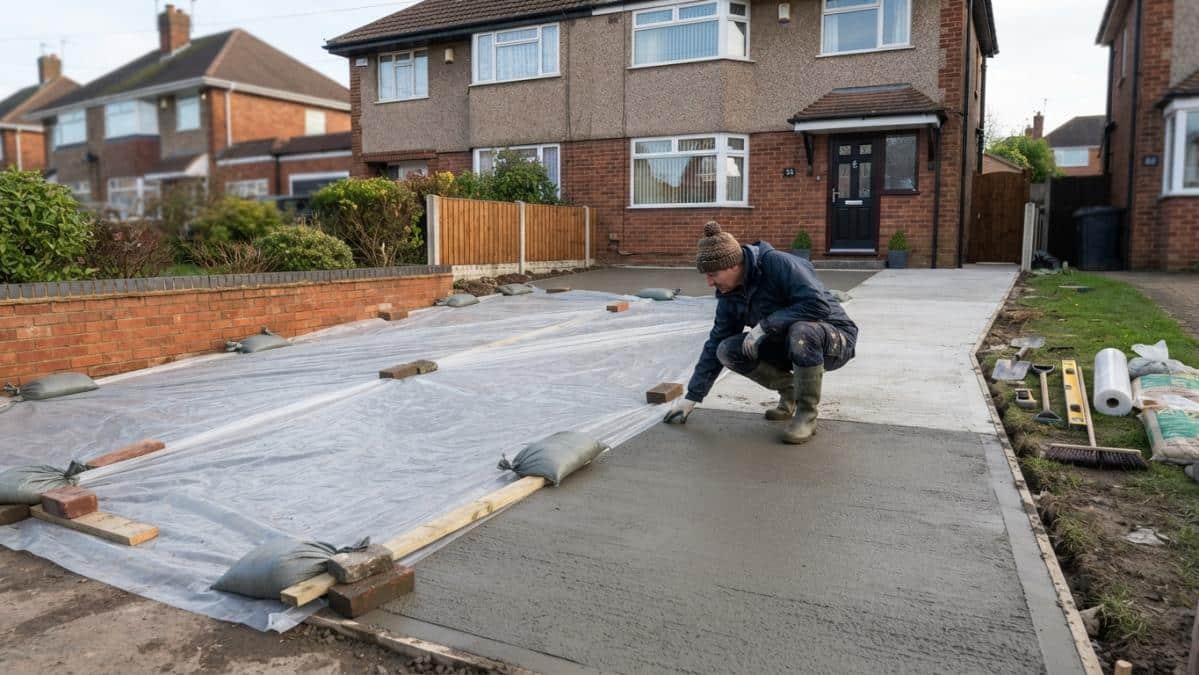
Cover the slab with polythene sheeting for the first week, weighted at the edges. This traps moisture so the concrete cures rather than dries. Keep it damp, not soaked.
Then:
- Keep vehicles off until day 7 at the earliest
- Redirect downpipes and hoses away from the new slab
- Don’t let anything heavy sit in one spot
- Avoid de-icing salt for the first winter
- Sweep rather than pressure-wash for the first month
Watch out: sealing a new driveway too soon traps moisture inside and can cause the surface to flake. Wait until the concrete has cured properly before applying any sealer.
Common Mistakes That Crack New Concrete
The same handful of errors crack most new driveways. Avoiding them costs nothing.
- Driving on too early. The number one cause of cracked edges and rutted surfaces.
- Pouring in bad weather. Frost or driving rain during the pour weakens the top layer.
- Skipping the cover. Uncovered concrete dries too fast and surface-cracks.
- Too much water in the mix. A wet mix is easier to lay but weaker once set.
- No expansion joints. Slabs need room to move with temperature changes.
- Heavy loads too soon. A skip or delivery lorry on a week-old slab is asking for trouble.
A common mistake is judging readiness by look alone. A slab that looks hard can still be weak underneath.
Choosing the Right Mix for a Driveway
The right mix matters as much as the curing time. A driveway takes vehicle loads, so it needs a stronger mix than a patio or footpath. For most domestic driveways, a standard air-entrained mix at the right strength does the job, and air entrainment helps the concrete survive British winters and de-icing salt.
Strength is graded by the familiar C-label, such as C25 or C30. Your supplier should advise on the right grade for your job rather than leaving you to guess. At Gills Mix Concrete, we use only virgin quarried materials and offer expert advice on concrete strengths, so you order the right mix first time.
If you’re deciding on a mix and want to see the supply and pumping options available, you can find out about our ready mix concrete services for domestic and commercial jobs.
Ordering Your Driveway Concrete Mix
Ordering is the easy part once you know your volume and mix. Get the quantity right and the pour runs smoothly. Get it wrong and you’re either short mid-pour or paying for concrete you don’t need.
Work out your volume first. Use our concrete calculator for mix on site concrete to find out how much your project requires. Driveway slabs are usually calculated in cubic metres: length × width × depth. If you’re unsure how much concrete you need, our guide and readymix concrete calculator can help. A typical driveway slab is around 100mm deep, though heavier use needs more.
Always add a little extra for spillage and uneven ground.
When you’re ready, contact the Gills Mix team for free advice and a quote. We offer same or next-day delivery and 24/7 availability for out-of-hours pours, so a time-sensitive job doesn’t have to wait.
Frequently Asked Questions
How long should you wait before driving on a new concrete driveway?
Plan for at least seven days before a car goes on a new driveway, and treat that as a minimum rather than a green light for heavy use. Concrete curing continues well beyond that point, so keep light vehicles to a minimum for the first couple of weeks. Full design strength is normally assumed at 28 days, which is when heavier vehicles and regular traffic become safe. Cold, wet weather pushes every one of those milestones back.
Can you drive on concrete after 7 days?
At seven days a standard driveway mix has usually gained enough strength to take a car, provided the weather has been reasonable and the slab was cured properly. Keep heavy vans, delivery lorries and skips off it for longer. If the pour happened in near-freezing conditions, add days rather than assuming the calendar has done the work. Ask your supplier for the mix specifics so you know what strength you are working with.
Does cold or wet weather affect concrete curing time?
Yes, significantly. Concrete curing is a chemical reaction that slows sharply as temperatures drop, and below about 5°C the set can almost stall. Wet weather is less of a problem for strength gain than frost, but standing water and rain hitting a fresh surface can wash out the top layer. Cover the slab, avoid pouring onto frozen ground, and expect cold-weather pours to need extra days before traffic.
What should you do to protect a new concrete driveway while it cures?
Keep vehicles off for at least a week, keep foot traffic light for the first few days, and cover the surface if frost or heavy rain is forecast. Don’t let skips, scaffolding or plant sit on the slab, and keep de-icing salt away for the first winter. A curing membrane or polythene sheet helps retain moisture in warm weather. If you are unsure whether the slab is ready, wait a few more days rather than risk a crack.
Getting a driveway pour right comes down to patience and the right mix. Rush the curing and you’ll pay for it in cracks, ruts and repairs. Gills Mix Concrete supplies BSI-certified concrete across Wolverhampton and the West Midlands, with expert advice on strengths, free local delivery and out-of-hours service when your schedule demands it. Get started with Gills Mix Concrete and pour your driveway with confidence.

Recent Comments